.png)
Is Plasma Fibroblast Right for Me? 7 Things to Know Before Non-Surgical Skin Tightening in Torrance
If you’ve been seeing “plasma fibroblast” or “non-surgical eye lift” on your feed and wondering if it’s legit, you’re not alone. A lot of our clients at Radiant Ink come in asking the same question:
“Is Plasma Fibroblast actually worth it, or is it just another trend?”
When it’s done correctly and on the right candidate, Plasma Fibroblast can be a powerful way to tighten loose skin and soften lines without surgery. When it’s done poorly—or on the wrong skin—it can cause frustration and disappointment.
This guide breaks down seven key things to know before you book, so you can decide if Plasma Fibroblast is a good fit for you.

1. Plasma Fibroblast is about tightening, not filling
Plasma Fibroblast is a skin-tightening treatment. It doesn’t add volume like filler or relax muscles like Botox. Instead, it uses a tiny plasma arc to create controlled “micro-dots” on the surface of the skin.
Those dots instantly contract the tissue and trigger fibroblast cells (your collagen-producing cells) to go into repair mode. Over the next several weeks, your skin slowly looks firmer, smoother, and more lifted in the treated area.
It’s ideal for clients who say things like:
“My upper lids are starting to droop.”
“My under-eye skin looks crepey in photos.”
“These fine lines around my mouth are really bugging me.”
If you’re looking for more volume (for example, fuller cheeks or lips), other treatments will be a better match. Plasma Fibroblast shines when the main issue is loose, crepey, or lined skin.

2. The most popular treatment zones are the eyes, mouth, and neck
Most people discover Plasma Fibroblast through “non-surgical eye lift” posts, and there’s a reason for that: the eye area responds beautifully when it’s treated correctly.
Common treatment areas include:
Upper eyelids (hooded or droopy lids)
Under-eye wrinkles and crepey skin
Crow’s feet at the outer corners of the eyes
Lines around the mouth and “smokers lines”
Smile lines and marionette lines
Mild looseness along the jawline or neck
Small patches of crepey skin on the body (stomach, knees, etc.)
At Radiant Ink, we’ll always start with what bothers you most and then let you know which areas are realistic to treat with Plasma versus where another option might make more sense.
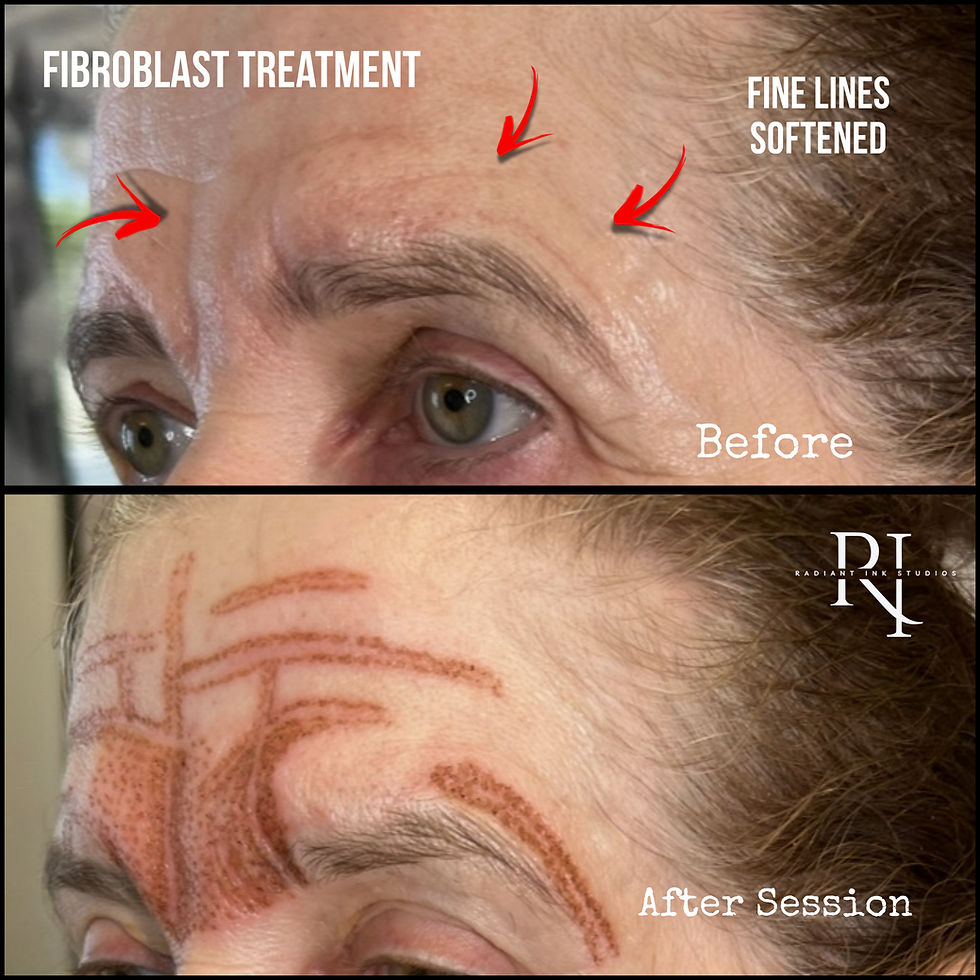
3. There is downtime, and you’ll be able to see it
Plasma Fibroblast is non-surgical, but it still counts as a real procedure, which means real healing.
Here’s what most clients in Torrance experience:
Days 1–3: Swelling and tightness, especially around the eyes. Tiny brown “carbon crusts” are clearly visible where each dot was placed.
Days 4–7: Swelling settles. The dots dry out and begin to flake off on their own. The area can feel a bit dry or itchy.
Days 7–10: Most crusts are gone. The new skin underneath may look pink and “fresh.”
Weeks 3–12: Under the surface, collagen and elastin are rebuilding. This is when tightening and smoothing really become noticeable.
During the first week, you’ll want to avoid:
Heavy sweating, saunas, and hot tubs
Direct sun on the area
Makeup on the treated skin until it has closed
Picking or scratching the dots (ever)
We give every client a Fibroblast aftercare guide with day-by-day instructions so you’re never guessing what to do while you heal.

4. Results are gradual—but can last years
One of the biggest misconceptions is that Plasma Fibroblast is an instant miracle. You will notice some immediate tightening right after your session, but the real magic happens slowly as your skin rebuilds itself.
Typical timeline:
Early tightening: right after treatment (from tissue contraction)
Visible change: around weeks 3–6
Best result: around weeks 8–12, as new collagen sets in
Many clients enjoy their results for 2–3 years or longer, depending on age, sun exposure, and general skin health. Your skin will still continue to age naturally, but Plasma Fibroblast can turn the clock back on very specific areas that bother you.
5. You might need more than one session
Some people see the improvement they wanted after a single session. Others need a series of two or three treatments, especially if:
The skin is very loose or crepey
There are deeper etched-in lines
The area has significant sun damage
We space sessions out, giving your skin time to fully heal and rebuild between treatments. During your consultation at Radiant Ink, we’ll be honest about whether you’re more likely to be a “one-session” or “multi-session” client based on what we see in person.

6. Not everyone is a good candidate—and that’s a good thing
A big part of keeping Plasma Fibroblast safe is saying no when it isn’t the right choice.
You may not be a candidate if:
You are pregnant or breastfeeding
You have very dark skin (Fitzpatrick 5–6), due to higher risk of pigment changes
You have a history of keloid scarring
You have certain medical conditions or are on medications that affect healing
Clients with medium-deep skin tones (Fitzpatrick 4) sometimes need a test patch first so we can watch how the skin responds before doing a full treatment.
If we don’t feel Plasma Fibroblast is appropriate for you, we’ll tell you clearly and won’t push you into it. Long-term skin health always matters more than squeezing in another service.
7. Who you choose matters more than which device they use
There are many brands of plasma pens on the market, and it’s easy to get lost in the marketing. In reality, your results have more to do with:
The training and experience of your practitioner
How they pattern the dots and control energy
How honestly they evaluate your skin and risk factors
The aftercare protocol they give you (and that you follow)
At Radiant Ink, we treat Plasma Fibroblast the same way we treat permanent makeup and paramedical tattooing: with precision, conservative planning, and full transparency about what’s realistic.

Is Plasma Fibroblast right for you?
If you’re in Torrance or the South Bay and you’ve been thinking about a non-surgical option for hooded lids, under-eye wrinkles, or fine lines around the mouth, Plasma Fibroblast might be worth a conversation.
The best next step is a proper consult:
We’ll look at your skin in person
Talk through your goals and medical history
Explain what kind of result you can realistically expect
Go over pricing, downtime, and aftercare before you commit
To ask questions or see if you’re a good candidate, call or text 424-224-6477 or book online.


Comments